
Short answer: Ultra High Speed HDMI certification proves one thing: the cable assembly itself passed the HDMI Forum’s bench tests at an Authorized Testing Center — bandwidth, protocol compliance and EMI. It does not prove that your source and display can do 8K, that your format will train at your length in your rack, or that the cable in front of you is the certified one. Those five gaps are where buyers get burned, and each one has a question you can ask instead.
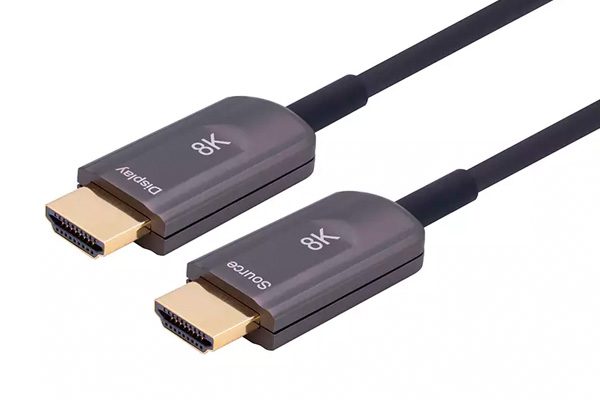
The Ultra High Speed HDMI Cable Certification Program is run by HDMI Forum and administered through HDMI LA. If you are buying long-distance AOC rather than retail patch cords, the program’s fine print matters more than the logo — so here is what it covers, and what it leaves to the buyer.
What the Ultra High Speed HDMI Certification Program Actually Is
The Ultra High Speed HDMI Cable is the HDMI 2.1a Category 3 cable: a 48 Gbps assembly (four lanes at 12 Gbps in Fixed Rate Link mode) qualified to carry every HDMI 2.1a feature — uncompressed 4K@120, 8K via DSC, HDR, VRR, eARC. Certification is not optional: every Ultra High Speed HDMI Cable model, of any length, must pass testing at an HDMI Forum Authorized Testing Center (ATC).
Three mechanics are worth knowing:
- EMI is part of the pass criteria. Certified cables must meet low-EMI requirements precisely because a 12 Gbps-per-lane link radiates — the test exists so certified cables do not jam Wi-Fi, Bluetooth and streaming boxes around them.
- Active and optical assemblies are in scope. The specification permits wire, passive, active and converter Category 3 assemblies, so an AOC can be certified like any other — the optical conversion inside does not exempt it.
- The market is audited. HDMI buys certified cables in stores and online and re-tests them at ATCs; repeat failures suspend the supplier’s ability to order more certification labels.
A certified cable carries the Ultra High Speed HDMI Certification Label on its packaging, with a QR code verifiable in the HDMI Cable Certification app, and the cable name printed on the outer jacket. That is the entire visible surface of the program — everything else is bench data the buyer has to ask for.
Five Things Ultra High Speed HDMI Certification Does Not Prove
1. It does not upgrade anything you already own
The Ultra High Speed HDMI certification is a bandwidth ceiling, not a feature. A certified 48 Gbps run between a 4K@30 source and a 4K@30 display delivers exactly 4K@30. Bandwidth is negotiated by the two devices at link-up (Fixed Rate Link training); the cable’s job is to not be the bottleneck. Nobody should buy an Ultra High Speed cable expecting a TV to gain refresh rates, HDR formats or VRR it never shipped with.
2. It does not promise your format at your length in your rack
Ultra High Speed HDMI certification testing happens on the ATC bench. Your install is not that bench: different connectors, a different temperature, cable dressed alongside mains cabling, a source and sink pair the lab never saw. FRL link training is a negotiation between your specific devices over your specific run — and a 48 Gbps link has far less margin at 80 m than at 10 m.
This is why the question that matters for a long AOC run is not “is it certified” but “does it hold my format at my length” — and the answer should come from a length-specific factory test report, not from the label. For the distance side of that question, see how far an 8K HDMI cable can run.
3. It does not tell you whether DSC is in the picture
DSC (Display Stream Compression) is negotiated between source and display. A cable certified for 48 Gbps carries whatever the two ends agree on — compressed or not. That distinction matters at the top of the format range: 8K@60 4:4:4 exceeds what even 48 Gbps carries uncompressed, so it depends on DSC being present and enabled at both ends. “Certified” on the package says nothing about whether that negotiation will happen on your gear. Ask what format the link runs — native or DSC — at your resolution, and get it in the quotation.
4. It does not make an unlabeled cable a bad cable
The Ultra High Speed HDMI certification label is a floor, not a ceiling. Plenty of competent AOCs ship without the Ultra High Speed label — some are certified and the box predates the label program, some are factory-direct B2B where the label program is retail-oriented, and some are simply uncertified. What separates the good ones from the junk is not the sticker but the test data behind them.
So when the label is absent, replace it with paperwork: ask the supplier for a factory test report covering eye diagram at the ordered length, bit-error rate under FRL, and EMI results. A manufacturer with an in-house lab will send this without being asked twice. A reseller who cannot will tell you everything you need to know.
5. It does not decide the product details that actually bite
Certification says nothing about the features that determine whether an AOC survives your project: the eARC return path (not every 48 Gbps build provides one), direction marking (an AOC is one-way, and a reversed run is a black screen — the mechanics are in why fiber optic HDMI cables are directional), connector style for the install (lock screws for rigging, over-molding for brand OEM), and jacket construction for the route. Those are part-number decisions, and they are yours.
Buying a 48 Gbps AOC Without Guessing
| Part number | Construction | Best fit | What to ask for with it |
|---|---|---|---|
| PHDC-9860 | Standard Type A–A, 48 Gbps | Rack installs, processor-to-display runs | FRL test report at the ordered length |
| PAHC-9860 | Armored Type A–A | Conduit pulls, rental stock, public venues | Crush and pull test data plus the FRL report |
| PHOM-9860 | Over-molded connector | Brand OEM builds, custom molding | Molding drawing and the FRL report under the custom part |
| PSAC-9860 | Super slim armored | Narrow conduit, tight cabinet routing | Minimum bend radius spec plus the FRL report |
All four are 48 Gbps HDMI 2.1 AOCs rated 8K@30 4:4:4 and 8K@120 with DSC, HDCP 2.3, 1–100 m. Every one ships with a factory test report on request — which is, in practice, the document that answers what the Ultra High Speed HDMI certification label cannot. The range detail lives on the fiber optic HDMI AOC product page.
Questions We Get Before Orders
Is every “8K HDMI cable” certified? No. “8K-ready” on a retail box is marketing; the Ultra High Speed HDMI certification label is the only official claim there is. A cable without the label is not automatically bad — but it shifts the burden of proof to the test report, so ask for one.
Is Premium High Speed the same thing? No — that is the older HDMI 2.0-era program for 18 Gbps cables. If a supplier offers you “Premium certified” cable for an 8K project, they are selling you the previous generation’s stamp.
Do I still need to worry about direction and eARC? Yes. Certification covers the assembly’s electrical and EMI performance, not your install discipline: AOCs are one-way, and the eARC return path is a design choice per part number. Confirm both with the sample before the wall closes.
What if the link trains at a lower format than quoted? That is a link-training result, not a cable defect on its own. Capture the source and display models and the length; a manufacturer with a lab can reproduce it on a bench and tell you which end limited the link.
Next step
Send us the source, the display, the format and the run length. We will come back with the part number that holds that format at that length, the factory test report behind it, and a sample to prove it on site — request a quote. If the fault you are chasing is in an existing install, start with the seven causes of an HDMI AOC not working.
Related posts:
 In fiber HDMI cabling projects(Wiring ducting), if the cable is accidentally routed backwards,how to solve?
 Analysis of the application of HDMI cables in data centers
 DP 2.1 vs HDMI 2.1: Uncover the Truth Behind the Interface Battle – Avoid Wasting Your Money
 HDMI 2.1 vs DP 2.1 Comparison Guide: Full Technical Analysis of Display Interfaces