Short answer: yes — fiber optic HDMI cables are good for gaming when the run is longer than about 3–5 m and you need 4K@120, VRR or ALLM to survive the distance. The optical conversion adds nanoseconds, not milliseconds, so it cannot be the source of input lag. Below 3 m, passive copper is cheaper and equally fast. Beyond that, copper at 48 Gbps starts dropping exactly the features players notice, while a fiber AOC holds the negotiated format.
Gaming questions about fiber HDMI cluster around four things: latency, whether 120 Hz and VRR really work, whether audio return survives, and what happens when the cable is reversed or bent. This page answers them in specification terms so you can order a length that performs on installation day the way it did on the bench.
Where fiber helps a gaming setup — and where it does not
HDMI 2.1 uses a fixed-rate link of four lanes at up to 12 Gbps each. That leaves very little headroom: 4K@120 with 10-bit colour and 4:4:4 chroma consumes nearly all of the 48 Gbps. Copper attenuation rises with frequency and length, so a passive cable that handles 4K@60 at 5 m can fall back to a lower refresh at 8 m. The screen still shows a picture; the game just feels different.
Choose fiber when the console sits in a cabinet, the PC drives a projector across a room, a sim rig crosses a frame, or a tournament setup needs a clean routed path. Choose passive copper for a desk-length connection between a PC and a monitor. Fiber does not improve colour or sharpness over a short run — both media are digital, and intact bits produce an identical image.
The gaming features the cable actually has to carry
Bandwidth is only part of the specification. These are the features that make a long run feel like a gaming run:
| Feature | What the player notices | What the link needs |
|---|---|---|
| 4K@120 Hz | Motion clarity, lower input lag | Full 48 Gbps end to end |
| VRR / ALLM | No tearing; TV switches to Game Mode | HDMI 2.1 signalling through every device |
| 8K30 4:4:4 | Unaltered 8K chroma | 48 Gbps; our fiber HDMI AOC spec |
| 8K120 | High-refresh 8K | DSC compression required |
| eARC | Lossless audio back to the soundbar | Copper return path inside the AOC |
Two rows deserve attention. First, 8K120 is not an uncompressed mode — it needs DSC, and every device in the chain must negotiate it. Second, eARC is a return channel, not a forward video feature. A fiber AOC carries video on glass but keeps a copper pair for low-speed side channels; if that pair is omitted, a cable advertised as 48 Gbps can still fail eARC. We wrote the checks in do fiber HDMI cables support eARC.
If the source is a PC with DisplayPort 1.4 rather than HDMI, the equivalent fiber DP AOC reaches 100 m (300 ft) at HBR3, and 8K@60Hz there also requires DSC 1.2. Same principle, different connector — do not mix the two spec sheets when quoting a gaming room.
Latency: the number that settles the argument
Light travels through fiber at roughly 5 ns per metre, so 30 m adds about 0.00015 ms. The transceivers add less than 0.000002 ms at each end. One frame at 240 Hz lasts 4.17 ms — around 28,000 times longer. Human reaction time is roughly 100 ms. The fiber contribution is not merely small; it is below anything a player or a display can resolve.
So when a long run “feels laggy,” look at the format, not the medium. We put the full time comparison and a ten-minute swap test in whether fiber HDMI cables add lag. The short version: a cable cannot add milliseconds; a format fallback can.
Five long-run faults that get mistaken for a slow cable
- Silent format fallback. An AVR, switcher or wall plate that cannot pass 48 Gbps drops the link to 4K@60 or disables VRR. Check the display’s on-screen info before buying another cable.
- Post-processing. A TV with Game Mode off applies motion interpolation and noise reduction worth tens of milliseconds — thousands of times the fiber’s contribution.
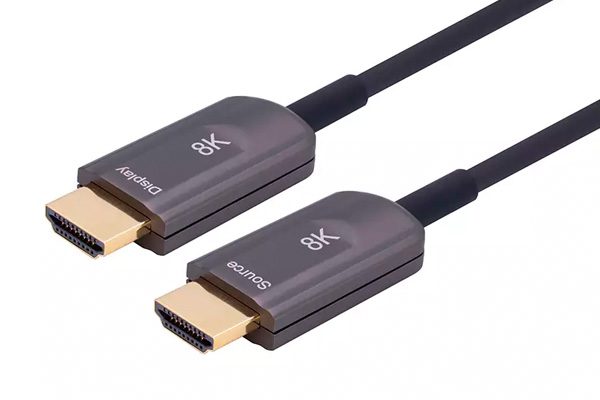
- Reversed direction. An AOC is directional: the transmitter is permanently at the Source end and the receiver at the Display end, and it draws its power from the source connector only. Reversed, you get no image, not a slow one. See why fiber HDMI cables are directional.
- A splitter in the chain. HDMI splitters and switches change EDID negotiation and +5 V current draw; a run that works direct can fail through a switch. Our splitter guide isolates power, EDID and bandwidth causes.
- Bends and pulls. Fiber breaks below roughly a 20 mm radius on a 4.0 mm jacket while the outside still looks fine. Respect the installed radius; bend radius rules for in-wall runs give the pulling and installed limits.
Order checklist for a gaming AOC
| Check | What to confirm before the PO |
|---|---|
| Source and display | Model, HDMI revision, and the highest format both advertise |
| Target format | 4K@120, 8K30 4:4:4, or 8K120 with DSC — write it down |
| Routed length | Path plus service loop; 10–100 m fiber HDMI available |
| Audio path | eARC required? Confirm the copper return pair is specified |
| Chain devices | AVR, switcher, wall plate — each must pass the same format |
| Installation | Source/Display labels visible, bend radius respected, no field re-termination |
FAQ
Will a fiber HDMI cable give me lower ping?
No. Network latency is set by the route and the server, not the display cable. What fiber protects is the negotiated video format at length, which is why a 4K@120 link may feel better than a copper run that quietly fell back to 60 Hz.
Is fiber HDMI worth it for a 2 m console-to-TV run?
No. A certified passive cable is cheaper and has no electronics. Fiber earns its price when distance, EMI from power gear, or a tight conduit makes copper unreliable.
Can I use one for PS5, Xbox or a gaming PC?
Yes — all use standard HDMI connectors and HDCP handshakes pass transparently. Match the cable to the format you want at the length you need, not to a brand name.
Next step
Tell us your source device, display model, target format and routed length. We manufacture fiber optic HDMI AOC cables from 1 to 100 m in 18 Gbps and 48 Gbps versions, at fixed lengths with OEM branding. Request a quote or a sample and we will return the part number with a test report at your length — before you commit to a run that cannot be re-terminated on site.